This site has been created to facilitate the establishment of a South East Asian biochar interest group. BIG-SEA could provide communication and linkage between biochar researchers, farmers, related industry and supporting organisations, interested in tropically focused biochar industry development. Please get in touch if you are interested in supporting or participating in this effort.
We make a small amount of biochar yearly to be used in our nursery
potting soil and applied to our garden beds. Biochar has been studied
extensively over the past 25 years and has proven to be an effective
soil fertility strategy, in particular in the tropics. We use two
different biochar systems. The first is a cook stove called an Estufa
Finca. This was developed by our friend Art Donnelly of SeaChar.org. The
second is a larger retort kiln called a TLUD (Top-Lit Up-Draft) made of
two 55 gallon metal drums.
Biochar is a fascinating soil amendment that inspires much
disagreement and conversation. For us, we are mostly interested in
leveraging the unique physical and chemical properties of biochar to
reduce leaching of nutrients, improve soil structure, buffer our pH, and
provide host sites for microorganisms. Biochar in general has a
negative molecular charge which binds well to nutrients and it’s
physical structure provides endless nooks and crannies for a diversity
of microbial life to seek shelter from predators.
We primary use fruit tree and bamboo prunings for our biochar feed
stock. We avoid nitrogen rich feed stock as this nitrogen volatilizes
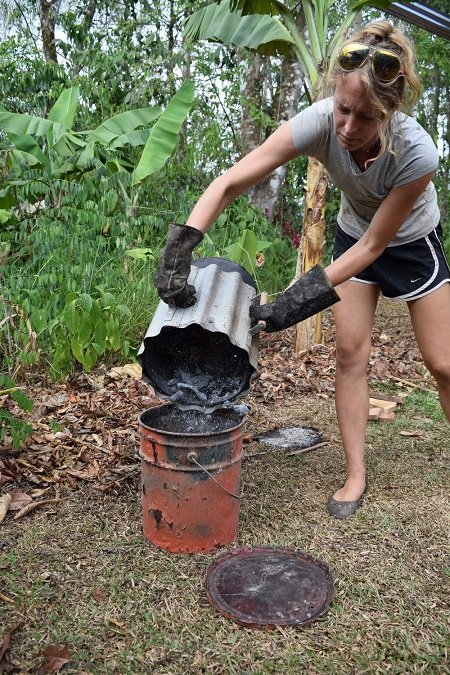
during the combustion process. After a burn, which can be seen in the
following photos, the biochar is crushed and then charged. As the burn
process removes most nutrients from the remaining carbon, it is most
effective to soak the biochar in a nitrogen rich liquid. Typically we
use effluent from our methane biodigestors. An
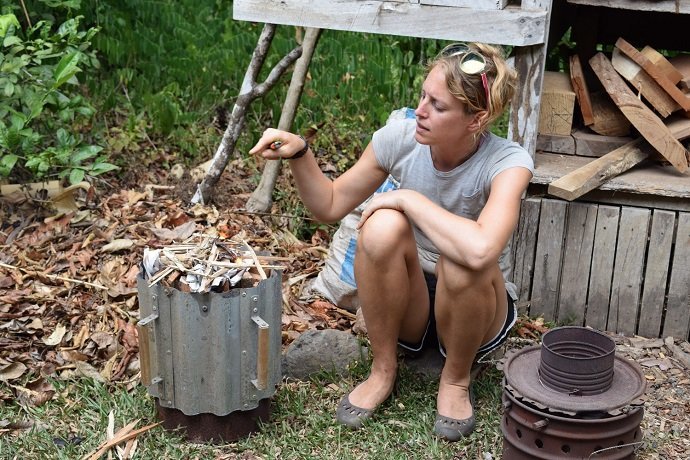
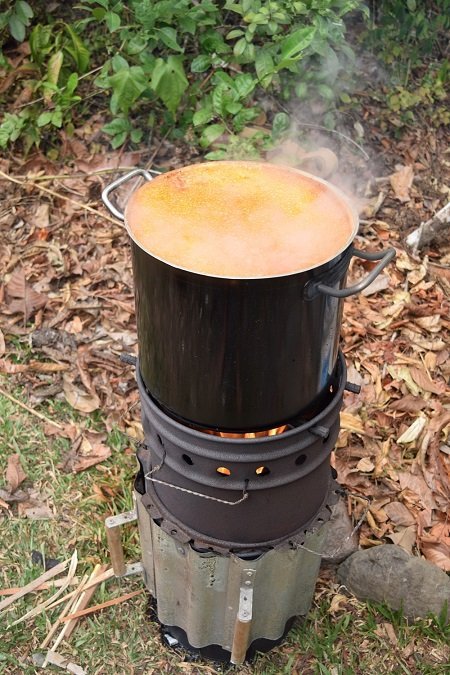
Estufa Finca cook stove is stocked and started. This highly efficient
stove boils a gallon of water in under 10 minutes and produces biochar
as a bi-product.Turmeric is being processed on the stove to make a live-cultured soda and obtain a dried spice.As the stove dies down, the combustion is stopped by dumping the contents into a quench bucket.
The biochar is then incorporated into our potting mix or worked into
resting garden beds. Occasionally we apply this amendment directly to
tree planting holes, in which case we apply ½ kilo per tree hole and top
dress under the mulch another ½ kilo.
Overall biochar does not make up a huge part of our day-to-day work. I
find it challenging to find the time and physical space for all the
necessary harvesting, handling, and drying of feedstock. This year we
will make 60 to 120 kilos of biochar for our gardens.
Versammlung
-
*"harvested themes from an ecocentric life"*
*Some German ecovillages *(Ökodorf) take their carbon footprint so
seriously that they don’t allow compute...
Nurtured by and dedicated to te reo Māori
-
Te reo Māori is Dr. Anaha Hiini’s life purpose. Raised by his grandparents,
Kepa and Maata Hiini, Anaha of Ngāti Tarāwhai, Tūhourangi, Ngāti Whakaue
descen...
Biochar for gardeners
-
Biochar is charcoal used to improve the quality of soil for growing plants.
Biochar particles mixed into soil will make the soil loose and friable for
bett...
maccybiochar is in business!
-
Please find below a summary recently issued by maccybiochar: maccybiochar
is a not-for-profit volunteer group set up to convert tree litter from
local hous...
Is Mahogany the Answer?
-
Is Mahogany the Answer?
True Mahogany or “Genuine Mahogany” is of the Swietenia genus. The Khaya
genus is “close enough” however Shorea genus or Philippi...
Morels! - Waterman and Hill-Traveller's Companion
-
Morel Mushrooms
Morels are mycorhizal fungi, that is, they live symbiotically on the roots
of some species of trees. Apples, elms, poplars and ashes are ...
Hoverboards – Which one should You Choose?
-
As we’ve seen these past year, hoverboards have become very popular and
look super cool. Today, there is a variety of different types of
hoverboardsavbaila...
Save the Arctic
-
*by Renaud de Richter*
*Links*
- This idea was proposed by Denis Bonnelle,
'Solar Chimney, water spraying Energy Tower, and linked renewable en...
Delivering on the promise of soil carbon credits
-
[This is a test. Just emerging from a fog. What did I mist? Back to work.
Carbon Farmers of Australia is committed to making the first soil carbon
methodo...
Updates:
-
Well, things have changed over the last year and at the moment I'm up in
British Columbia having gotten married at the first of the year. All is
well, life...
-
*Cody's Corner*
[image: family4.jpg]
Big Profits
We practice a method of agriculture here at Real Farm Foods that is old as
the earth and made more acces...
Adoption of Niger Seed
-
In 2010, an ECHO Asia Notes article entitled *The Recent Introduction of
Niger Seed (Guizotia abyssinica) Production in Northern Thailand* described
how ...
TAKING THE STEP
-
Yup! I'm starting a new walk. I've been toying with the thought for awhile.
I liked my previous retreat from the Internet and I'm doing it again, this
tim...
Installing the ONIL Stove in Guatemala
-
Last year I had the good fortune to link up with a small NGO in Panajachel,
Guatemala - Mayan Families - and they were kind enough to let me help them
inst...




 Posts
Posts


