Translator

Wednesday, 12 September 2018

Rice growing, biochar trial in Thailand

Gordon Hirst has sent me a link to a Facebook page that is recording a 5-year rice growing field trial in Thailand which includes biochar.
https://www.facebook.com/onetonperrai/

The page needs an introduction to set the scene but if you scroll to the start (3 July 2017), you can review progress via video posts and trial records...

"A field experiment using both a biochar fertilizer/ soil enhancement and SRI (system of rice intensification) to attempt to double the yield of a working farm, from 500 Kg/Rai to 1000 Kg/Rai. The farm is paddy rice farm located in Nakhon Ratchasima province ten Rai (1.6 Ha). The experiment will last for five years"

Friday, 7 September 2018

Biochar social enterprise in Thailand (part 3 of 5)

Cool the Climate, Clean the Environment, Improve Public Health, Reduce Rural Poverty with Small-Scale Biochar - Part 3

President, Board of Directors at Warm Heart Worldwide, Inc. 14 articles

Sows’ Ears into Silk Purses

On Sun, Sep 2, 2018 at 8:42 PM 'd.michael.shafer@gmail.com' d.michael.shafer@gmail.com [biochar] <biochar@yahoogroups.com> wrote:
  Here is the 3rd article in the 5 part series, this one focused on how a small-scale biochar social enterprise business model can (and does) work.

https://www.linkedin.com/pulse/cool-climate-clean-environment-improve-public-health-reduce-shafer-2d/

For those of you who are frustrated with the drip feeding of articles, this link will take you to a downloadable PDF of all five:   https://warmheartworldwide.org/cool-the-climate-pdf/ 

SOC decline in tropical plantation soil - new evidence

This new report should be of interest to all plantation industries and forest managers... and should support more interest in biochar production and application opportunities...

Changes in soil organic carbon stocks after conversion from forest to oil palm plantations in Malaysian Borneo

Abstract

"The continuous rise in the global demand for palm oil has resulted in large-scale expansion of industrial oil palm plantations - largely at the expense of primary and secondary forests. The potentially negative environmental impacts of these conversions have given rise to closer scrutiny. However, empirical data on the effects of conversion of forests to industrial oil palm plantations on soil organic carbon (SOC) stocks is scarce and patchy. We evaluated the changes in SOC stocks after conversion of tropical forest into oil palm plantations over the first and second rotation period in Sarawak, Malaysian Borneo. Soil samples were collected from three age classes of oil palm plantations converted from forest (49, 39 and 29 years ago respectively) with three replicate sites and four adjacent primary forest as reference. In each site under oil palm, the three management zones namely; weeded circle (WC), frond stacks (FS), and between palm (BP) were sampled separately. All soil samples were collected from five soil layers (0–5, 5–15, 15–30, 30-50 and 50-70 cm). Samples were analysed for SOC concentration, soil bulk density, pH and soil texture. Results showed SOC stocks declined by 42 %, 24 % and 18 % after 29, 39 and 49 years of conversion respectively. Significant differences in SOC stocks were found among different management zones in the oil palm plantations, and the trend was similar for all age classes: FS>WC>BP, demonstrating the necessity of considering within-plantation variability when assessing soil C stocks. The largest differences between SOC stocks of the reference forest and converted plantations were found in the topsoil (0-15 cm depth) but differences were also found in the subsoil (> 30 cm). Our results will contribute towards future modelling and life cycle accounting to calculate the carbon debt from the conversion of forest to oil palm plantations."

Biochar project report from Malaysia


Prof. Rob Bachmann from UniKL has kindly shared the following report on some of the biochar work he is currently connected with in Malaysia.

1. Universiti Kuala Lumpur (UniKL) under project leader Dr Nadia Razali has teamed up with MPHTJ, a Melakan municipality, to develop a carbon negative solution for their yard as well as wet market waste. A news video of the signing ceremony is available here: https://youtu.be/ahCMo4QiBK0.

In our project we aim to convert the brown waste (wood) to biochar testing the flame curtain and retort technology.


The biochar will subsequently be added to the green compost as bulking agent, to immobilise leachate and speed up the composting process. The final mature compost can be used as substitute for inorganic fertilizer in MPHTJ nurseries or sold to third parties such as organic farmers.

2. Another project involved a collaboration between UniKL and Top Fruits Sdn Bhd (http://topfruits.com.my/) with the aim to convert their orchard waste into a valueable product. Our project concluded that Durian wood biochar produced with the Kon-Tiki earth kiln technology can partially substitute peatmoss in fruit tree nurseries without negatively affecting plant growth and health. Organic fertilizer was not required during the first 3 months. Plant height was found to be the most accurate and yet easy and affordable growth monitoring parameter. For more information please read our paper here: https://link.springer.com/article/10.1007/s12517-018-3792-z.

3. Research collaboration between UniKL and the Malaysian Palm Oil Board (MPOB) focusses on 3 aspects: i) converting oil palm biomass residues to biochar, ii) characterisation and identification as well as iii) application. Our latest publications report on the effect of humic acid coated PKS biochar on NPK adsorption (https://doi.org/10.21894/jopr.2018.0029) as well as effect of pyrolysis temperature and holding time on biochar yield and carbon stability using All Powers Lab Biochar Experiment Kit (BEK) (https://doi.org/10.21894/jopr.2018.0043).

4. Collaboration between a local chicken farm and UniKL aims to develop a scale-able solution for their chicken litter (CL) waste that can reduce the smell and fly problem, destroy pathogens and preserve as many nutrients as possible at an affordable price. At present, lab-scale pyrolysis of CL was successfully deployed to stabilise the biomass in the form of biochar. Poultry litter biochar produced at 400°C for 60 min retains all major plant nutrients (P, K, Ca, Mg, S) except for nitrogen (58 ± 15 % retention).

5. Another UniKL project led by Dr Amelia Md Som seeks to develop a solution to ameliorate acid sulfate soils using bio-physico-chemical approach. Biochar is being produced from oil palm fronts with an earth as well as metal Kon-Tiki kiln. Preliminary findings have been presented at and are available in the Proceedings of the 10th International Symposium on Plant-Soil Interactions at Low pH, June 25-28, 2018, Palm Garden Hotel IOI Resort Putrajaya, Malaysia.


Tuesday, 28 August 2018

SEA Haze issue: article Part 2 of 5

Here is part 2 of Michael Shafer's 5-part series. Part 1 can be found by scrolling down...


Cool the Climate, Clean the Environment, Improve Public Health, Reduce Rural Poverty with Small-Scale Biochar - Part 2


President, Board of Directors at Warm Heart Worldwide, Inc. 12 articles

Thursday, 23 August 2018

Social enterprise in Bali includes biochar


https://www.eastbalicashews.co/eco-friendly-energy/

"Believe it or not, cashew shells are an important part of our business. The circular journey of the cashew shells starts at our factory. To power the steaming and drying process of our cashews, we use an innovative gasifier furnace that runs on leftover cashew shells. We then use the resulting biochar as a super carbon-rich fertilizer for our cashew trees and rosella plantations.

Our excess cashew shells we pass on to other small businesses, such as commercial laundries, which use the shells to heat their boilers. While the shells may seem like a simple byproduct with little value compared to the cashews themselves, they’re actually integral to our operations and need to be managed with care.

In 2016, we started to take the “use the whole cashew” idea to the next level. We have ambitious plans to replant Bali’s – and eventually Indonesia’s – cashew trees within the next decade. Part of this plan involves buying old cashew trees from farmers to make space for the new seedlings. We are using the wood chips from these trees to fire our furnaces as well, leaving no part of the cashew – or its tree – unused."
info@eastbalicashews.com

Crop residue burning in Thailand - WarmHeart (part 1of 5)

Dr Michael Shafer's work with biochar from his 'WarmHeart' base in northern Thailand is well reported here (see WarmHeart tag). Michael is kicking off a 5-part report focused on crop residue burning. Below is his announcement on this to the yahoo international biochar discussion group. It is a highly relevant read for those of us interested in solving regional haze issues.
d.michael.shafer@gmail.com
Aug 21 3:04 AM
"I live in North Thailand where smoke from burning  corn and rice fields blocks the sun a couple of months a year. Burning wheat straw smoke closes Delhi every year, too.

Because most of the farmers who burn are poor and small, collecting their crop waste for central processing is uneconomical and their fields are too small, too steep, too rocky to plow, even if they could afford a tractor.

They are so poor, however, that converting their crop waste to biochar makes lots of sense. Establishing village-scale social enterprises to process local biochar into value added products is also not only appealing to farmers but a replicable way to solve the crop waste burning problem where it starts - in small farmers' fields.

This is the first of a five part series in which I make the case for a small-scale biochar social enterprise business model for addressing the problem. The remaining four will appear over the next few weeks.


I would welcome any comments, suggestions, corrections or criticisms."


photo
Dr. D. Michael Shafer
Founder and Director, Warm Heart
61 M.8 T.Maepang A.Phrao 50190 Chiang Mai Thailand

Friday, 13 July 2018

Biochar activities in Thailand

Dennis Enright is a kiwi who travels to Thailand regularly to work with NGO's on biochar and sustainable farming practices. We have collaborated on biochar development in NZ which has included running biochar training workshops in May/June. We also hope to soon collaborate on biochar projects in SEA with other regional NGO's and consultants.

The following report from Dennis is just one of a number of projects he is working on in Thailand. Others include coffee growers and coconut farmers... reports on these projects in the pipeline.

You can Contact Dennis from his NZ website: http://nzbiocharltd.co.nz/

Making Biochar from Mulberry Prunings at Khon Kaen, Thailand – June 29th 2018

Dennis Enright (NZ Biochar Ltd)

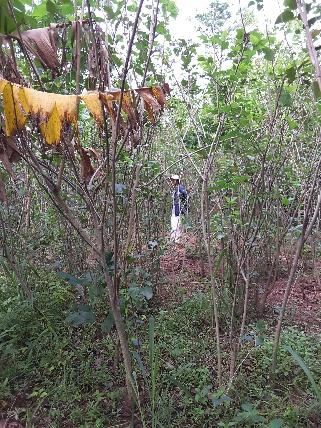
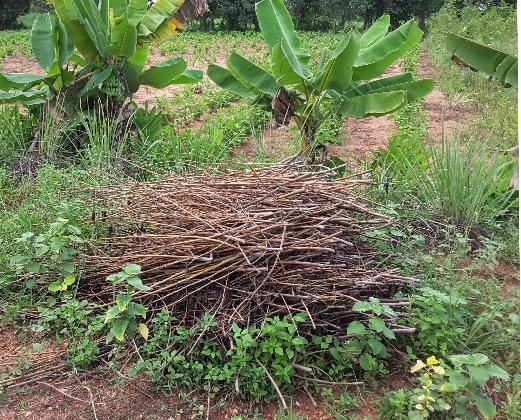
Mulberry bushes are grown to produce mulberry leaf tea (and for silk worms). During the growing period leaves are regularly picked from the stems and by the end of the growing season most stems are bare of leaves and are about 2-3 metres high. At this time the stems are cut off at about 10 cm from the base, removed, and stacked in piles around the edges of the field until they are dry and can be burnt. The mulberry plant then produces new shoots and the annual cycle continues.


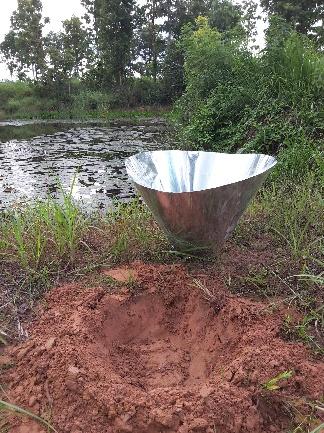
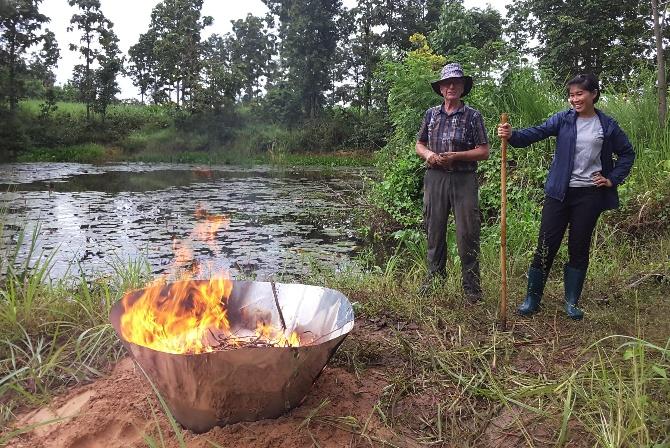
In June of this year GreenNet Cooperative staff and I visited Ban Hin Herb village (Tambon Prayuen, Prayuen District, Khon Kaen) where we used a metal lined Kon-tiki pit kiln to make biochar from Mulberry bush prunings, and then applied some of this biochar to mulberry plants in a simple experiment to evaluate the effects.

I chose a lined Kon-tiki method because on a previous occasion where biochar was made using damp coconut material in a flat bottomed concrete tub, not all the material charred well. This probably happened because in a container with a large flat bottom it is difficult to get a good base of hot char below the newly applied material to help dry it before more charring occurs.

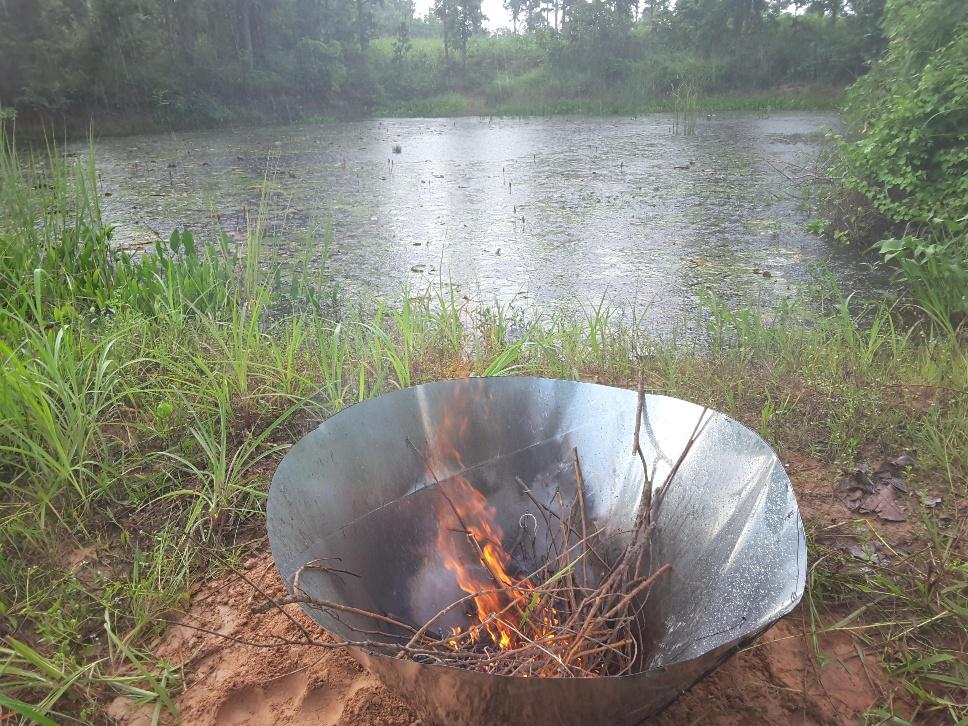
The Kon-tiki pit liner was made at the village using light gauge sheet metal held into shape with wire, both bought locally and costing less than 500 bt in total.

Making biochar with the lined Kon-tiki worked well, even though the prunings were still partially green (about one month old), and the weather was very humid and for a short time near the start of making biochar it rained quite heavily (see photo).

So while there may be other containers that can work, this is the most effective way to make biochar (refer to research work of Schmidt H P and Taylor P)

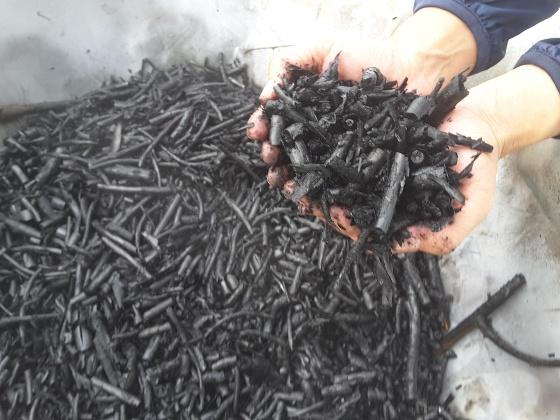
Also mulberry prunings were easily turned into biochar that was quite soft and had a very noticeable soapy feel to it.

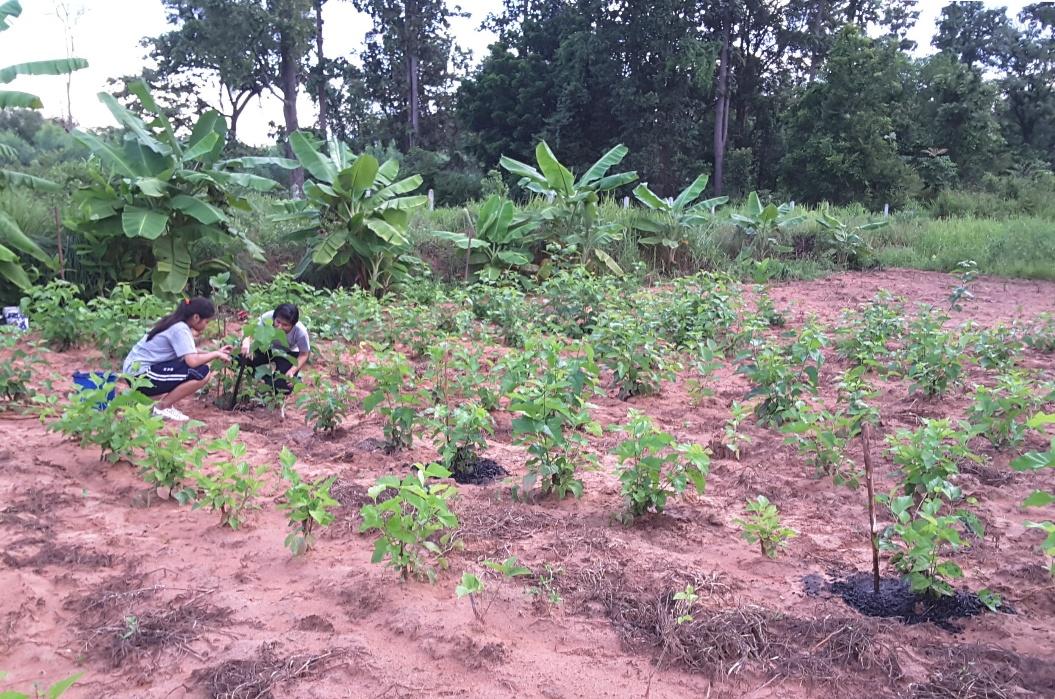
Some of this biochar was then primed with a slurry of chicken manure/rice husks and used in an experiment. The treatments were; 5 litres of primed biochar per plant (place in a circle - diameter of 30 cm), and 5 litres of chicken slurry only.

These treatments were applied to plants in a single row in the following order starting at plant 7 from the road side:

Plant 7 primed biochar, plant 8 no treatment, plant 9 chicken slurry, plant 10 no treatment, Plant 11 primed biochar, plant 12 no treatment, plant 13 chicken slurry, plant 14 no treatment, Plant 15 primed biochar, plant 16 no treatment, plant 17 chicken slurry, plant 18 no treatment (see photos)

The soil here is sand with very low amounts of organic matter. This experiment is situated on an organic farm and we are interested in determining if biochar can increase the effectiveness of nutrients applied in the usual organic fertilisers such as compost that the farmers apply. If treatment effects become apparent, then assessments can be done using a scientifically acceptable visual scoring procedure and the results statistically analysed.

RFP for biochar consultants in Vietnam


https://vietnam.rikolto.org/en/news/consultancy-biochar-experts


"Rikolto in Vietnam (previously VECO Vietnam) is a member of Rikolto, an international NGO with its International Office in Leuven, Belgium. Rikolto’s mission is to enable and support smallholder farmers to take up their role in rural poverty alleviation and to contribute to feeding a growing world population in a sustainable way. Rikolto is currently implementing the 2017-2021 programme “Supporting Inclusive and Sustainable Agricultural Value Chain Development Benefiting Smallholder Farmers in Vietnam” with a focus on vegetable and rice value chains.

In April 2018, Rikolto started implementing the project “Reducing Greenhouse Gas Emissions from Rice Production in An Giang Province, Vietnam, through Alternate Wetting and Drying and Biochar Production”. This project is a first step to making our target rice value chains more environmentally-friendly and climate-smart. As part of this project, we are looking for a (team of) consultant(s) to assess the feasibility of transforming rice waste into biochar and market it."

Thursday, 12 July 2018

International Biochar Seminar, Indonesia

I received a late invite to "Biochar for Sustainable Soils", hosted by Bogor Agricultural University, about 60km south of Jakarta. The line up included quite a few international stars of the biochar world that I've met before at various conferences and workshops: Johannes Lehmann; Stephen Joseph; Annette Cowie; Lukas Van Zwieten; Gerard Cornelissen; Ruy Korscha.
https://www.dropbox.com/s/okmay1ljg9vm2vy/B4SS%20program.pdf?dl=0

You can click on the image adjacent for a better view of the program.

The event was based around the completion of Biochar for Sustainable Soils (B4SS), 4-year, a multi-million dollar international program (see B4SS label for other posts). It was attended by ~140, mainly from Indonesian agriculture and research community but included representatives from other participating B4SS countries and Malaysia.

The presentations should be available for download in the future... I'll post on this when they come available.

Tuesday, 12 June 2018

Biochar Malaysia Ass. AGM

My thanks to Dr Sieng-Huat Kong from University College of Technology Sarawak for the following report...

4th BMA Annual General Meeting and Biochar Technology Workshop 2018

The AGM was held on 14th May 2018 at Faculty of Engineering, Universiti Putra Malaysia (UPM). Prior to the commencing of AGM, all the 60 participants were brought to visit the biomass microwave carbonizer pilot plant located inside UPM, which is the collaborative work between UPM and Pakar Go Green Sdn Bhd. The plant can process 250 kg/hour of feedstock (oil palm biomass, coconut shell, bamboo, etc) in batch process and returns up to 50% yield on biochar. Besides, bio-oil is also collected for further research as value-added products compared to biochar as the main product solely.

After the visit and on-site discussion with Pakar Go Green personnel, participants were invited back to the workshop in the faculty with two speakers sharing on their experiences in the industry and academic research in terms of the technology and application of biochar. The 4th AGM commenced right after the workshop, started with the report from previous AGM by the committee members. New management committee for session 2018/2019 was formed with Assoc. Prof. Dr. Mohamad Amran bin Mohd Salleh and Prof. Datin Dr. Rosenani binti Abu Bakar as President and Vice President respectively. More discussions and works proposal were carried out throughout the one hour plus meeting with the aim to contribute positively towards the community, especially the agriculture sector.


Friday, 18 May 2018

Recently Published Biochar-related Resources (May 2018)

Recently Published Biochar-related Resources (May 2018)
RECENTLY PUBLISHED BIOCHAR-RELATED RESOURCES
May 2018
Robert Gillett , Editor
Papers in this list are from last month’s new ‘biochar’ entries in Google Scholar. Quotes are from the papers, which are accessible through the links provided. These have been extracted by IBI Newsletter Editor Robert W. Gillett to keep the length of this addendum manageable, yet informative enough to prompt further investigation by readers. Emphasis was placed on highlighting new findings leading to practical application, but with the expectation that decisions will be informed by accessing the full publication.

URLs followed by the padlock symbol link to open access articles.

Monday, 14 May 2018

IBI Biochar Study Tour - Austria | 18-21 June 2018

IBI Biochar Study Tour - Austria | International Biochar Initiative

"IBI is excited to announce our second Biochar Study Tour to be held in Austria from June 18-21, 2018.  We are collaborating with Gerald Dunst, CEO of Sonnenerde and Gerhard Soja from the Austrian Institute of Technology; we have been working towards creating an educational and inspiring event.  We are hard at work on the agenda at this stage but wanted to share the overall themes and tours that will be included so that those interested could make their travel reservations early.  Space is limited, so reserve your spot now!" ...