Translator

Showing posts with label NGO. Show all posts

Friday, 13 July 2018

Biochar activities in Thailand

Dennis Enright is a kiwi who travels to Thailand regularly to work with NGO's on biochar and sustainable farming practices. We have collaborated on biochar development in NZ which has included running biochar training workshops in May/June. We also hope to soon collaborate on biochar projects in SEA with other regional NGO's and consultants.

The following report from Dennis is just one of a number of projects he is working on in Thailand. Others include coffee growers and coconut farmers... reports on these projects in the pipeline.

You can Contact Dennis from his NZ website: http://nzbiocharltd.co.nz/

Making Biochar from Mulberry Prunings at Khon Kaen, Thailand – June 29th 2018

Dennis Enright (NZ Biochar Ltd)

Mulberry bushes are grown to produce mulberry leaf tea (and for silk worms). During the growing period leaves are regularly picked from the stems and by the end of the growing season most stems are bare of leaves and are about 2-3 metres high. At this time the stems are cut off at about 10 cm from the base, removed, and stacked in piles around the edges of the field until they are dry and can be burnt. The mulberry plant then produces new shoots and the annual cycle continues.
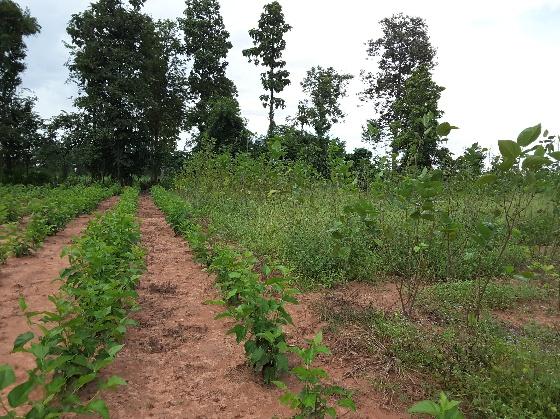
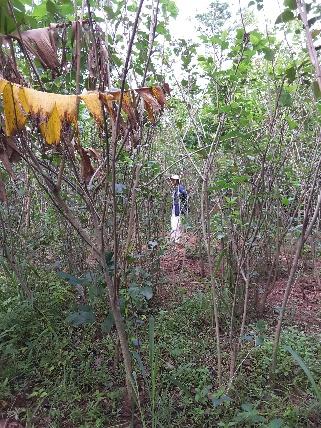
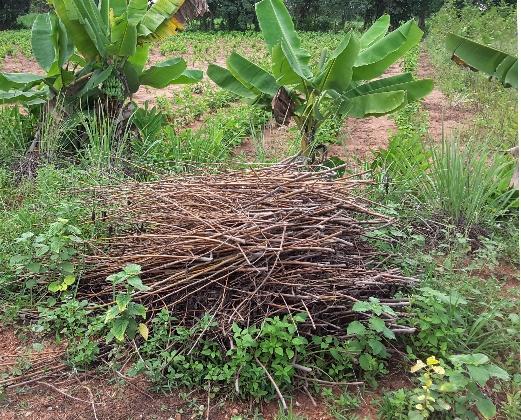
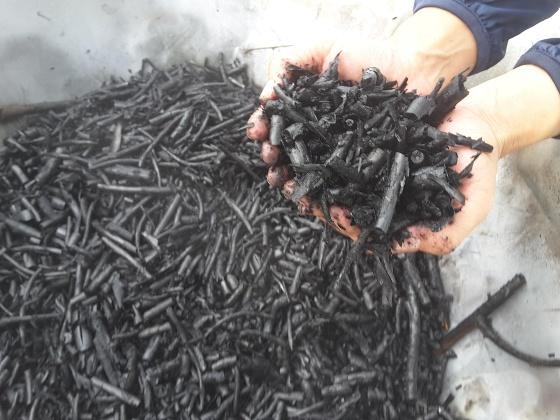
In June of this year GreenNet Cooperative staff and I visited Ban Hin Herb village (Tambon Prayuen, Prayuen District, Khon Kaen) where we used a metal lined Kon-tiki pit kiln to make biochar from Mulberry bush prunings, and then applied some of this biochar to mulberry plants in a simple experiment to evaluate the effects.

I chose a lined Kon-tiki method because on a previous occasion where biochar was made using damp coconut material in a flat bottomed concrete tub, not all the material charred well. This probably happened because in a container with a large flat bottom it is difficult to get a good base of hot char below the newly applied material to help dry it before more charring occurs.
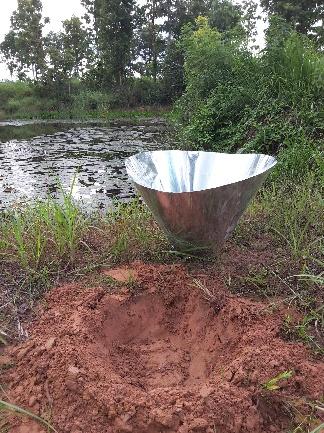
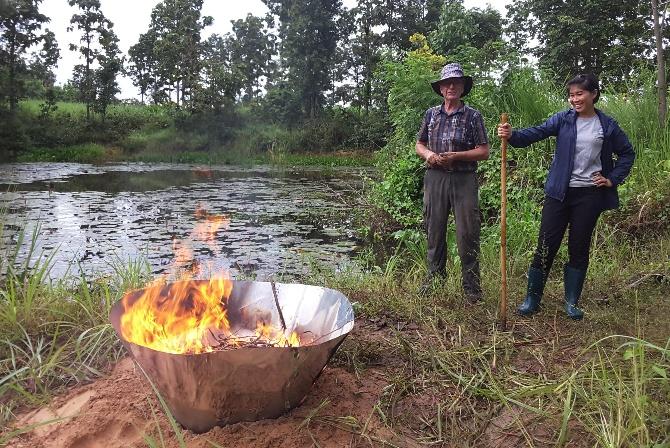
The Kon-tiki pit liner was made at the village using light gauge sheet metal held into shape with wire, both bought locally and costing less than 500 bt in total.

Making biochar with the lined Kon-tiki worked well, even though the prunings were still partially green (about one month old), and the weather was very humid and for a short time near the start of making biochar it rained quite heavily (see photo).
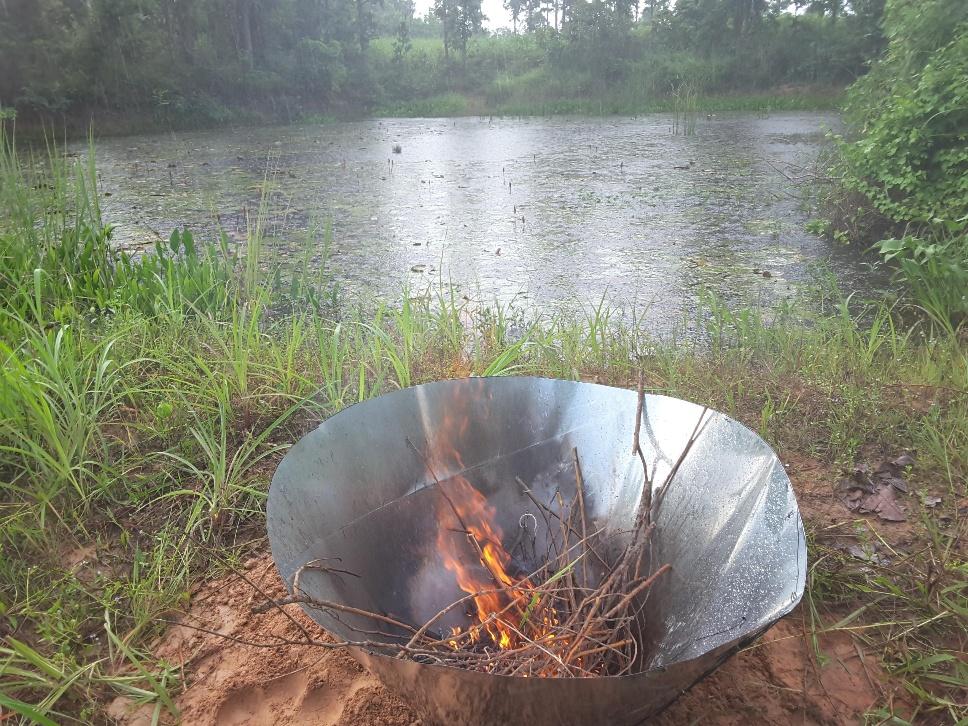
So while there may be other containers that can work, this is the most effective way to make biochar (refer to research work of Schmidt H P and Taylor P)

Also mulberry prunings were easily turned into biochar that was quite soft and had a very noticeable soapy feel to it.

Some of this biochar was then primed with a slurry of chicken manure/rice husks and used in an experiment. The treatments were; 5 litres of primed biochar per plant (place in a circle - diameter of 30 cm), and 5 litres of chicken slurry only.

These treatments were applied to plants in a single row in the following order starting at plant 7 from the road side:
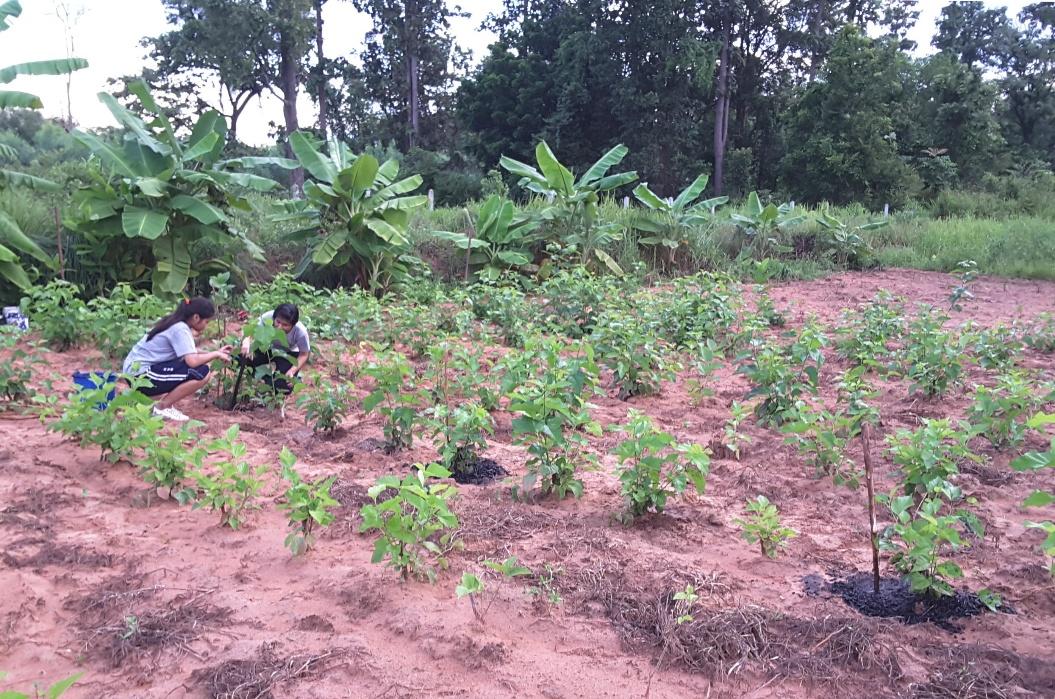
Plant 7 primed biochar, plant 8 no treatment, plant 9 chicken slurry, plant 10 no treatment, Plant 11 primed biochar, plant 12 no treatment, plant 13 chicken slurry, plant 14 no treatment, Plant 15 primed biochar, plant 16 no treatment, plant 17 chicken slurry, plant 18 no treatment (see photos)

The soil here is sand with very low amounts of organic matter. This experiment is situated on an organic farm and we are interested in determining if biochar can increase the effectiveness of nutrients applied in the usual organic fertilisers such as compost that the farmers apply. If treatment effects become apparent, then assessments can be done using a scientifically acceptable visual scoring procedure and the results statistically analysed.

RFP for biochar consultants in Vietnam


https://vietnam.rikolto.org/en/news/consultancy-biochar-experts


"Rikolto in Vietnam (previously VECO Vietnam) is a member of Rikolto, an international NGO with its International Office in Leuven, Belgium. Rikolto’s mission is to enable and support smallholder farmers to take up their role in rural poverty alleviation and to contribute to feeding a growing world population in a sustainable way. Rikolto is currently implementing the 2017-2021 programme “Supporting Inclusive and Sustainable Agricultural Value Chain Development Benefiting Smallholder Farmers in Vietnam” with a focus on vegetable and rice value chains.

In April 2018, Rikolto started implementing the project “Reducing Greenhouse Gas Emissions from Rice Production in An Giang Province, Vietnam, through Alternate Wetting and Drying and Biochar Production”. This project is a first step to making our target rice value chains more environmentally-friendly and climate-smart. As part of this project, we are looking for a (team of) consultant(s) to assess the feasibility of transforming rice waste into biochar and market it."

Sunday, 24 December 2017

Thursday, 13 July 2017

B4SS have been active in Indonesia & Vietnam

Check out B4SS activities in Vietnam and Indonesia.
​
From: Ruy Korscha Anaya de la Rosa korscha@gmail.com [biochar] 
Date: 13 July 2017 at 16:17
Subject: [biochar] B4SS Adventure Experience in Peru
To: biochar@yahoogroups.com


Starfish's Biochar for Sustainable Soils (B4SS) project is entering its final year and things are getting really exciting. The results of the last 2-3 years of research are coming in and our focus is now shifting to sharing this practical and important knowledge. Check it out and you could win a trip to Peru!

http://biochar.international/peru-trip

Dr Ruy Anaya de la Rosa
Project Director | Biochar for Sustainable Soils
  a collaboration of Starfish Initiatives
/Inline image 1
__._,_.___
          

Monday, 17 April 2017

Fire Free Alliance and biochar?

There are some interesting carbon threads between the current ideas at FFA and my previous post on Michael Shafer article. Check out the video linked below...

http://www.firefreealliance.org/blog/w27tS5T6Z9PHAtyfv

Friday, 16 December 2016

Climate farming connecting local action and global comprehension ...

Climate farming connecting local action and global comprehension in the face of climate change


Hans-Peter Schmidt, Ithaka Institute, presents on communication strategies for FAO during their recent webinar series: Mitigation of Climate Change in Agriculture (MICCA) Programme

This is based on their success with biochar implementation in Nepal. 


Saturday, 12 March 2016

More media coverage on WarmHeart Haze solution

Biochar: a profitable solution to Thailand’s haze problem

... "Why not develop a solution to the haze problem that turns waste corn stalks into a valuable product?

This is what Theerasak Charassrivisist, director of the Chiang Mai Provincial Energy Office, is doing. Theerasak is teaching farmers how to turn their corn stalk and corncob into "biochar" - a pure form of charcoal - using do-it-yourself technology. "Pyrolysed" corn waste produces no smoke, no particulates, almost no greenhouse gases and actually removes CO2 from the atmosphere." ...

Sunday, 28 February 2016

Warm Heart shows a new way forward on haze issues

Could this be a pointer to wider solutions for haze in Indonesia? When plantations and commercial agriculture recognize the value the carbon in waste biomass then we may have found an economic, social and environmentally acceptable solution.


Some earlier posts on this...
http://sea-biochar.blogspot.my/search/label/haze

Wednesday, 3 February 2016

Vietnam B4SS Project

A visit to the Starfish website (http://starfish-initiatives.org/) lead me to Biochar for Sustainable Soils (B4SS) Project  and then on to two projects is SEA:


VIETNAM – B4SS PROJECT PROFILE

INDONESIA – B4SS PROJECT
(profile coming - working with an existing network of 1,750 small-scale women farmers with dryland cropping systems to improve soils affected by the 2004 tsunami).

Wednesday, 20 January 2016

Ithaka Climate Farming Odyssey to Nepal

Travel & Workshop in Nepal

Ithaka Climate Farming Odyssey to Nepal

The Ithaka Institute is pleased to announce that we are piloting our very first educational odyssey where travelers will not only experience the beauty and splendor of Nepal, but will learn how Nepali farmers are improving resiliency and creating new rural jobs through climate farming and biochar based agro-forestry.
Over an 8 day period, travelers will see parts of Nepal which are definitely off the beaten path. Though we will begin and end the journey in the capital of Kathmandu, we will travel to remote villages such as Nalang (Dhading) and Ratanpur (Tanahu) where Westerners are rarely seen. En route to Ratanpur we will visit the magnificent old-world charm of Bandipur, a mountaintop village 143 km West of Kathmandu. 

Thanks to restorative agricultural practices developed by Ithaka, a growing number of Nepali farmers are engaged in climate friendly farming and agroforestry and have achieved significant successes in improving yields while reducing costs.  Travelers will learn how farmers have thrived, despite an embargo on mineral fertilizers, by creating their own well balanced, organic fertilizers using biochar, livestock urine and bones.  They will learn how these slow release fertilizers are made and applied and may even try their hand at ploughing with water buffalo! Tours through agroforestry projects will highlight newly created best practices for tree planting and review the basics of carbon credits for such projects. Those that join this journey will also learn how essential oils are produced using a Kon-Tiki biochar kiln.

Through collaborative workshops and shared lunches with local farmers, travelers will have plenty of opportunities to exchange ideas on farming techniques, ask questions and share stories. Evenings will include local music, storytelling and dancing while tending fires and making biochar. Low key morning treks will provide time to admire beautiful views of the Himalayas while seeing terraced farming up-close.

This first foray into educational travel will have a limited number of spots (minimum of 8; maximum of 12 participants).  We are particularly interested in travelers with an adventurous spirit that are willing to interact with local farmers by exchanging their experiences and questions related to climate farming and who are interested in helping us shape itineraries for future Ithaka Odysseys! 

If you are interested in further information please contact Kathleen Draper.

Monday, 2 November 2015

Saturday, 7 February 2015

Biochar demonstration projects in Myanmar, Indonesia and Vietnam

This job advertisement identifies existing biochar demonstration projects in Myanmar, Indonesia and Vietnam. Closing date is 23Feb so still time to get your CV in! It is not clear what organisation is running this program. If you have some idea, please let us know - it would be nice to know more about these SEA projects.

Project Director - Sustainable Land Management

Job Summary
This innovative not-for-profit organisation has a proven record in supporting regional sustainability throughout Australia and beyond.  They are excited to be working on their largest initiative to date and seeking to appoint a passionate, capable and suitably qualified Project Director to lead this important global project. 
The purpose of the project is to demonstrate and promote the adoption of sustainable land management practices involving the use of innovative organic amendments, based on biochar. Funded by the United Nations Environment Program (UNEP) and the Global Environment Fund (GEF), the project's duration will be 2.5 - 3 years commencing early 2015.
Reporting to the Executive Director with accountability to a Technical Steering Committee, you will lead the project working with six existing biochar demonstration projects in the developing world locations of:  Peru, Myanmar, Aceh, China (Henan, Hunan, Anhui and Jiangsu), Kenya, Ethiopia and Vietnam.  Your responsibilities will include evaluation of the role and potential of biochar in SLM; building awareness, knowledge and improved understanding and establishing knowledge management dissemination systems – particularly for small landholders and farming groups; establishing local and international networks of demonstration sites and farming groups and providing training in the use of bochar.  Further aiding your success will be your strengths in coordinating and delivering in a complex project arena and establishing strong relationships and working effectively with a broad range of stakeholders including the six in-country partner organisations, the UNEP and GEF, agricultural landholders and farming groups.


Saturday, 3 December 2011

Biochar activity in Thailand

UBI Siam: Low tech biochar in Thai sustainable rural development & climate change mitigation

UB International (UBI) is a program dedicated to testing the concept that thinly distributed feedstock can be utilized to significantly contribute to timely global climate change mitigation through low tech biochar production in sustainable rural development amongst small scale farmers, herders and forestry workers and hopes to develop a network of sib-projects to first ground truth the concept and then begin an exponential increase of participating communities through a communities-mentoring-communities program.

"Biochar from thinly distributed feedstock for sustainable rural development and timely climate change mitigation is a new field in Thailand and we welcome interested researchers, community developers, volunteers and funders to work with us in developing an informal consortium of NGOs, Universities, communities and individuals interested in contributing towards these goals at these sites or other promising locations.

For more information see also the UB International webpage or contact Karl Frogner (UBI)."
The full IBI report can be found here... http://www.biochar-international.org/regional/UBI_Siam

Saturday, 19 February 2011

Promoting climate friendly bioenergy and food security in the Greater Mekong Sub-region

"Promoting climate friendly bioenergy and food security in the Greater Mekong Sub-region (assessing the possibilities for 2011)"
This was the title of the FAO and ADB sponsored  workshop at which I presented on biochar and the output from the Yunnan Biochar Study on 11 February at the ADB Thailand Resident Mission, Bangkok. As well as FAO and ADB the audience included representatives from EEP Mekong, UNDP, government agency reps from Finland, Norway, Denmark, Sweden, France, Japan and USA. Mae Fah Luang University, AIT and other independent agencies were also represented at this small, informal forum (~30 participants).
 The program included 6 presentations:
  • GMS partnership, activities on bioenergy and proposed program – Climate friendly bioenergy and food security (ADB) 
  • Bioenergy & Food Security – A regional perspective (FAO)
  • Possibilities for using microfinance for farm/household level bioenergy technologies (AIT)
  • Developing and testing standards for biomass energy in ASEAN (JGSEE)
  • Developing opportunities for public private partnerships in rural bioenergy (ECO-Asia)
  • Potential for biochar in the GMS (BSL-SaafConsult).
Please get in touch if you are interested in seeing any of these presentations. Please also refer to the earlier postings on the Yunnan biochar study.

Tuesday, 25 January 2011

Biocharm project - final report now available

This 100+ page report includes information on the field trials with rice husk chars from small scale gasifier systems in Cambodia.

"... While there has been much discussion of biochar as a sustainable strategy in developing countries, there have as yet been very few detailed case-studies from feedstock to field deployment. This report presents original field trial results using carbonized rice husk (CRH) and sugar cane trash and corn cob char. It aims to evaluate systems of feedstocks - energy conversion technologies - and agricultural use of biochar."

Tuesday, 18 January 2011

Biochar in slash-and-burn agricultural systems in Northern Laos

Bryan Hugill has provided the following project announcement summary for the IBI January newsletter...

Biochar in slash-and-burn agricultural systems in Northern Laos

SaafConsult will be working with the GTZ/GIZ in the Sayabouri province, Laos, in early 2011 to undertake an assessment of the technical feasibility for biochar applications as a complementary approach for REDD. The work aims to inform the Ministry of Agriculture and Forestry on the current status of implementing biochar as a carbon sequestration method in tropical countries and to assess the potential and technical feasibility for applying biochar in halting shifting cultivation (slash-and-burn) through the sustainable utilization of woody biomass to increase of soil fertility and improve carbon sequestration (slash and char).

For more information, please contact Bryan Hugill (bhugill@saafconsult.com / bryan.hugill@gmail.com)


Sunday, 14 November 2010

Ecodana biochar project in West Kalimantan, Indonesia

"In Indonesia, more than half of all women in the workforce are farmers, often because their household incomes are inadequate to meet their families’ food needs. Most farmers use high-priced chemical fertilizers. Unfortunately, these high priced fertilizers not only reduce household income but deplete the soil and cause health problems. Our partner Yayasan Dian Tama (YDT), a local Indonesian non-profit, is empowering women by training them in sustainable agricultural techniques, including how to create Biochar, a natural charcoal fertilizer which increases the fertility of the soil and reduces their dependence on costly chemical fertilizer. They will also train women in marketing so they can sell their products and make a profit. With your support, we can help these women feed their families and grow organic produce for sale while enriching the soil so they can continue to thrive and sustain the earth."
http://ecodana.com/1755/women-farmers-empowerment-through-charcoal-composting/

Ecodana is a San Francsico based social enterprise whose mission is to improve the lives of people in rural areas around the world by facilitating funding for sustainable projects in their communities.

Saturday, 23 October 2010

IBI October Newsletter - SEA contributions

The following two items have been sent to IBI for the October newsletter...


Workshop on Biochar - Production and Uses
Monday 22nd - Tuesday 23rd November 2010
Location: Angkor Village Resort, Siem Reap, Cambodia (www.angkorvillage.com)
Phone contact: Ms. Sarah Carter 011427383
Email: sarah.carter@ed.ac.uk
This meeting will discuss the current state of biochar production and use in Cambodia, and will explore the potential for development of new technologies – both large and small scale, with a particular focus on gasification cook stoves. Issues for consideration to policy makers, and prototype guidelines for sustainable biochar deployment as an agricultural soil amendment will be discussed.
Day 1 will be discussions and presentations, and day 2 will be optional field trips to biochar agricultural field trials, a commercial gasification unit, and a visit to biochar stove production including demonstrations. 
Biochar is the result of thermally treating biomass (including wood, agricultural residues, paper sludge) in a zero to low oxygen environment to produce a charcoal type material. 
Presentations based on your own work/experience on any of the above areas are welcome, please submit an abstract for consideration. Delegates are encouraged to bring display/demonstration materials and video films based on their work.
Travel and accommodation assistance can be offered to a limited number of participants from within Cambodia. Please note that delegates must attend the entire workshop in order to qualify for accommodation and/or travel assistance. As the desired number of participants is limited, not more than two delegates from a single organisation can register. 
This meeting is part of the ‘Enabling Bio-innovations for Poverty Alleviation in Asia Project’, funded through IDRC-CRDI (www.bioinnovationpolicies.ait.asia)

2)
The School of Sustainable Agriculture, Universiti Malaysia Sabah has begun a research project titled "Maize Response to Soil Amended with Biochar and Inorganic Phosphorus Fertilizer".The primary objectives of this study are (i) to examine the effect of rice husk biochar on the growth and yield of maize grown on a Malaysian mineral soil fertilized with triple superphospahte fertilizer and (ii) to determine maize phosphorus uptake. This is a final year research project by Thien Nyuk Yen under the supervision of Dr Mohamadu Boyie Jalloh. <jallohmb@yahoo.com>

There are some rather stunning photos after 6 weeks of this pot trial. PDF available on request.

Tuesday, 29 December 2009

New biochar study collaboration in Cambodia

MaD - Making a Difference for Good!: MaD Organic Farm is an Edinburgh University Biochar Experimental Farm!

I wonder if small stove technology is appropriate in the Cambodian rural setting? I've been advised that fossil fuel distribution for cooking is not entrenched and that there is a charcoal industry for cooking.

Would the introduction of biochar producing stoves, such as those promoted by Worldstove,
http://worldstove.com/products/luciastove-for-developing-nations/ be a catalyst for change? If freely available waste biomass could replace charcoal as the fuel of choice, and at the same time biochar is identified as improving crop yields & reducing local fertilizer costs / inputs, then a virtuous circle can develop.